International shipping · Free recipe book with newsletter
↘ CHILL TILES° · The C of ICED METHOD°

Only 3 bowls in the box?
Now you have infinite.

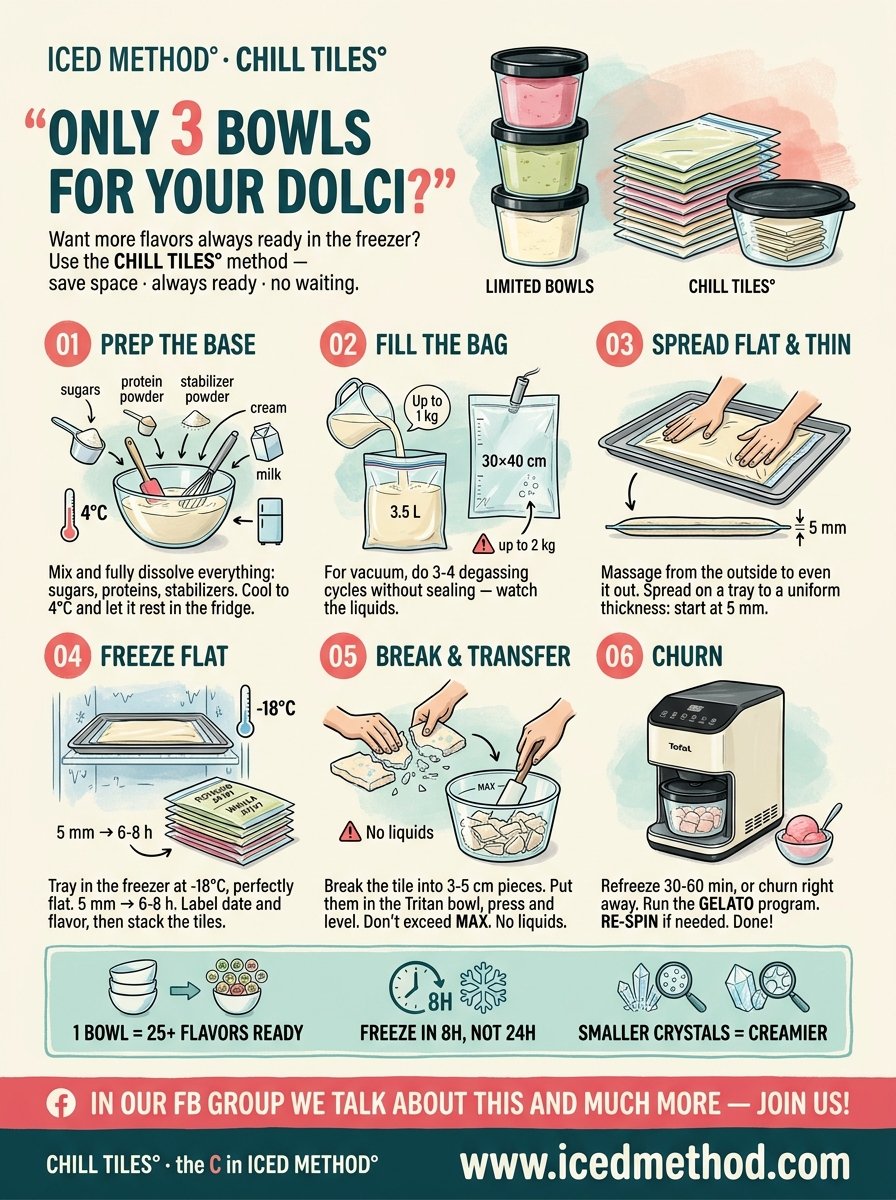
Stefano Chef's CHILL TILES° method turns your gelato bases into thin, flat, stackable tiles inside simple zip freezer bags or vacuum-seal bags. Your Moulinex Dolci or Tefal Dolci comes with just 3 Tritan bowls of 480 ml. Solution: 1 bowl is enough, the bases live as tiles in the freezer, always ready to process on demand.

✓ Moulinex Dolci ✓ Tefal Dolci ✓ Ninja Creami Deluxe ✓ Field-tested method
FREE BOOK · PDF · 9 PAGES

Get the complete CHILL TILES book.

Print, keep offline, read by the freezer while preparing your tiles. Complete book in PDF, free, 9 A4 pages with photos, calculations and step-by-step procedure.

⬇ Download the free book ~400 KB · 9 A4 pages
↘ 01 · The real problem

Three Tritan bowls. The end.

Open the box of your Moulinex Dolci (models MJ602AF0 Ivory, MJ604AF0 Ivory with spoon, MJ6038F0 Midnight Blue) or Tefal Dolci (NQ31IG04A Rise, IG602A Black Knight). Inside you find 3 Tritan bowls of 480 ml — the official French manual calls them "petits bols de congélation", in English "small freezing bowls". BPA-free, certified Reg. EU 10/2011. Three. Stop.

The Ninja Creami Deluxe (NC500, NC501) instead has the 710 ml XL pint in transparent plastic with MAX FILL Scoopable and Drinkable lines. Here too: 1 or 2 pints in the box, max 4 in deluxe bundles. The professional Pacojet, world reference for Michelin-starred chefs, works with beakers in stainless steel of 1 L filled to 80% — but that's another price range (€3,500+).

The #1 problem of the ICED Method community is always the same: 3 bowls are too few. Want 5 flavors ready for the weekend? Got a freezer full of other stuff? Want to prep bases in batches to save time? You need more containers. But the consumer market is empty: Moulinex and Tefal don't sell additional replacement Tritan bowls to the public, and the few spares available (on FixPart, DirectRepair, poliricambi.com) cost €30-60 each and are meant for technical service, not for scaling recipes.

I know from experience: the exact same thing happened with Ninja Creami. At first the extra containers were impossible to find, after 2 years Amazon was full of compatible third-party pints at €15 for 4. For the Dolci it'll be the same, but we need a solution now. CHILL TILES is that solution.

↘ 03 · The physics of tiles

Why thin is better. Heat exchange, crystals, texture.

This is the point that changes everything compared to freezing in the machine bowl. A thin tile freezes much faster than a thick block — and it freezes better, more uniformly, with smaller ice crystals. The final result is better.

The physical principle

The freezer cools the base from the surface inwards. Heat has to travel from the core of the mass to the outer edge, where the freezer's cold air absorbs it. The farther the center is from the surface, the slower the heat exchange.

  • Ninja 710 ml pint (vertical cylinder, ~9 cm diameter): the center is 4.5 cm from the nearest wall. Required freezing time: 24 hours.
  • Thin tile of 5-10 mm thickness: the center is 2.5-5 mm from the surface. Freezing time: 8-12 hours, sometimes less.

The tile's surface/volume ratio is dramatically higher. A 1 kg tile spread over 30×30 cm and 1 cm thick has about 1,800 cm² of surface exposed to cold air. A 700 ml pint has about 400 cm². Four times more surface for the same mass.

Consequence on final texture

Fast freezing = small ice crystals. Small crystals = smooth creamy final texture after scraping. Slow freezing = large crystals = sandy texture, noticeable on the tongue. Thin tiles, freezing fast, preserve base quality better than a thick block left to freeze 24h in the bowl.

Where to start with your trials

For your first trials, start with 5 mm thickness. It's the safest starting point: freezes in 6-8 hours, breaks by hand in a few minutes out of the freezer, and the malleability is optimal. From there experiment. If you want fuller tiles per flavor, go up to 8-10 mm. If you want maximum freezing speed and immediate malleability, go down to 3-4 mm.

Every base behaves differently: recipes with more fat (cream, chocolate) stay softer, watery recipes (fruit sorbets) freeze harder. Run trials, log thicknesses and times, find your optimal point for each recipe.

↘ 04 · Official glossary

Beaker · Pint · Tritan Bowl · Tile. Verified glossary.

Before proceeding, terminology clarity. Three different machines, three different official names in the manuals. Confusing them leads to purchase errors (buying wrong replacements) and procedural errors.

Tile · CHILL TILES vocabulary
Tile
In the CHILL TILES° system: a portion of base frozen flat and thin in a bag, ready to be processed. Plural: tiles. A 1 kg tile equals 1.5-2 equivalent pints.
Pacojet
Beaker (Becher DE)
Stainless steel 1 L · max fill 80% · official German/Swiss term. The English Pacojet manual uses "Pacotizing® beaker".
Ninja Creami / Deluxe
Pint
Transparent plastic · 473 ml standard NC299/NC300 · 710 ml XL Deluxe NC500/NC501 · with MAX FILL Scoopable + Drinkable lines.
Tefal · Moulinex Dolci
Tritan bowl
BPA-free Tritan · 480 ml × 3 included · "petit bol de congélation" in the official FR manual · "small freezing bowl" in EN. Three in the box of MJ602AF0, MJ604AF0, MJ6038F0, NQ31IG04A, IG602A.
↘ 05 · The three tiers of bags

Which bag to use. They're not all the same.

Three types with different characteristics, certifications and limits. The first is the most accessible and works for most users. The other two require specific equipment.

Key criterion: the bag must be sealable while lying flat. This is the technical condition that allows thin horizontal freezing. The zip wins on this point.

Pro tier · Professional chamber
30×40 cm chamber-vacuum bag
Tested capacity: 1.5 kg of base per bag
Material: Smooth multi-layer PA/PE, high barrier
Compatible machines: professional chamber vacuum sealer ($400-2000)
Vacuum pressure: 99.9% real vacuum, handles liquids
Degassing: at least 3 vacuum cycles without sealing, then seal
Typical use: restaurants, professional gastronomy
Pro: total vacuum even with pure liquids, storage up to 12 months.
Con: high initial investment, single-use bags.
Advanced tier · External bar
Embossed vacuum bags (bar sealer)
Material: Embossed multi-layer PA/PE, food-grade
Compatible machines: FoodSaver, Laica VT3117, Caso, Reber, Magic Vac
Temperature: freezer -25°C guaranteed
Sous-vide cooking: up to 90-95°C (useful for pasteurized bases)
Cost: $15-25 per roll 11" × 10'
Pro: real vacuum, up to 12 months freezer life, no flavor migration.
Con: requires vacuum sealer ($50-150), critical attention to liquids (see warning below).

⚠ Critical warning · Liquids in bar vacuum sealers

Domestic bar sealers (FoodSaver, Laica, Caso) suck air from the bag opening. If the base is fully liquid, it gets sucked into the sealing area, dirties the hot bar, and prevents proper closure.

Solution documented in the FoodSaver and Laica VT3117 manuals: pre-freeze the base 30-60 minutes until pasty consistency, then vacuum seal. Alternatively, if your machine has it, use the PULSE VACUUM function: pulls in short cycles that stop liquid movement before sealing.

With zip freezer bags this problem doesn't exist: close by hand, fill flat, freeze. The base path remains the safest for beginners.

Double bag · Always

Even with vacuum: one inner bag (zip or embossed) + one outer zip over-bag. Three reasons: protection against tears in the freezer, blocking aroma migration (neutral bases next to red fruits or pistachio contaminate in 7-10 days), extra food safety layer. Even if it seems excessive, do it.

↘ 06 · Step-by-step procedure

CHILL TILES° in 6 steps

01
Prepare the recipe

Mix all ingredients carefully. Fully dissolve sugars, powder proteins, stabilizers, salt. No lumps, no undissolved crystals. Tile quality starts here.

If the recipe is cooked (pasteurized, caramelized, reduced): cool fast to 4°C in an ice bath. Then let it mature in the fridge for a few hours (1-12 h recommended): hydrocolloids hydrate, flavors balance, air bubbles dissipate. Use plastic wrap touching the surface or an airtight container to prevent oxidation.

02
Transfer into the bag

Pour the cooled base into the bag:

  • 3.5 L zip freezer bag → up to 1 kg
  • 30×40 cm chamber vacuum bag → up to 1.5 kg

Expel the air. With a zip bag: Archimedes method (slowly immerse the bag in a bowl of cold water leaving the zip open at one corner, hydrostatic pressure pushes air out, close before the zip touches the water). With chamber vacuum: at least 3 degassing cycles without sealing — the liquid must not escape from the bag, watch closely — then seal at the last cycle.

Always double bag: the filled bag goes inside a second empty bag.

03
Manual mixing and flattening

Critical step often skipped. Once the bag is closed, mix the contents again manually by pressing and squeezing from outside. Ingredients must be distributed uniformly across the surface. If there are concentrations in one spot (e.g. denser cocoa at the bottom, nuts in one corner), the tile freezes unevenly.

Lay the bag on a support that keeps it flat: baking sheet, large plate, rack/grid, metal tray, inverted sheet pan. Distribute the contents manually until uniform thickness. For first trials: start at 5 mm. From there experiment towards 3-4 mm (faster) or 8-10 mm (more capacity).

04
Flat freezing

Tray in freezer at -18°C minimum, ideally -20/-22°C. Position perfectly flat. Freezing time:

  • 5 mm thickness: 6-8 hours
  • 8-10 mm thickness: 10-14 hours

Always label: preparation date, flavor, weight. Once tiles are frozen, remove the tray: tiles are now self-supporting and stackable. You can stack them in the freezer drawer.

05
Transfer into the Tritan bowl

Open the bag. Break the tile into large pieces (3-5 cm) with your hands or a sturdy spoon — the thin geometry allows it in seconds, even after only 8 hours of freezing.

Transfer the pieces into the Tritan bowl or pint. No liquid additions. Press well with the back of a spoon or a kitchen spatula to eliminate empty gaps between pieces. Level the top surface: it must be flat and compact.

Want maximum precision? Use the container lid (or the container itself) as a cookie cutter: it has the exact shape, cuts a perfect disc from the frozen tile. Not mandatory — spoon and spatula work just fine. It's an option for those who want to standardize portions.

Important: do not exceed the MAX fill lines on the container (MAX FILL Scoopable for Ninja, indicated level for Dolci). Overfilling = motor block or blade not working properly.

06
Consolidation and processing

Two equivalent options:

  • Option A · Refreeze first: place the filled Tritan bowl flat in the freezer for 30-60 minutes. The pieces weld into a uniform block. Then launch the GELATO or ICE CREAM program.
  • Option B · Process immediately + refreeze after: if the tile was well frozen, you can process right away. The resulting product will then be refrozen to consolidate texture.

RE-SPIN as default: if the first pass comes out grainy or powdery, re-spin smooths the texture. It's normal.

↘ 07 · Creative possibilities

What you can really do with tiles

Here tiles become a true combination kit. You have 5-8 flavors ready in the freezer, each in separate bags. Each tile is a card to play.

Sherbet · Sorbet + dairy base

Sherbet is fruit sorbet combined with a dairy base. Traditionally hard to make at home. With tiles it becomes trivial: process a tile of fruit sorbet (e.g. raspberry), add as mix-in or re-spin some pieces from a tile of dairy base (e.g. sweet cream) taken from another freezer bag. Result: raspberry sherbet with perfect dairy creaminess. Eyeball the dose: start with 20-30% dairy base, adjust to taste.

Two-flavor gelato · Swirls

Process a base, add pieces of a second tile as re-spin for visible streaks, or as mix-in for a more uniform integration. Classic example: vanilla + dark chocolate flakes pre-frozen as a separate tile → natural stracciatella effect, controlled by you.

On-demand frozen add-ins

Tiles don't need to be consumed in one go. Break only half a bag for today's gelato, close the bag back up and return it to the freezer with its label. Next time use it whole, or add it as small pieces as re-spin to another recipe. No more wasted gelato, no more "I want a specific flavor but I didn't prep it".

Operational example

1 kg bag of sweet cream: 500 g today for a full bowl, 250 g tomorrow as mix-in in a mango sorbet (= mango-cream sherbet), 250 g Saturday as a swirl in a chocolate gelato (= inverse stracciatella). One bag, three different desserts in three days.

↘ 09 · Disclaimer and manual interpretation

What the manuals actually say. Full transparency.

CHILL TILES° is an experimental community-driven procedure, not described in the official Tefal/Moulinex Dolci or Ninja Creami manuals. Neither explicitly authorized nor forbidden: simply not contemplated by the manufacturers' official flow. We quote verbatim the relevant manual passages and indicate how the method positions itself relative to them:

Tefal/Moulinex Dolci manual · Safety Instructions
"Do not prepare your food directly in the small bowl before freezing. Use a container suitable for this purpose."
The manual refers to a preparation container (pan, glass bowl, mixing bowl) for the initial hot or cold phase. It does not explicitly refer to the frozen storage bag of CHILL TILES. The official flow goes: external prep → cool to fridge temperature → transfer into the Tritan bowl → freeze in the bowl. CHILL TILES proposes a different flow (freezing in the bag, transfer to the bowl at use time) not contemplated by the manual.
Tefal/Moulinex Dolci manual · Operational limits
"Don't process a solid block of ice or ice cubes. Don't run a program if the preparation is not frozen flat."
The manual excludes pure ice blocks (frozen water) and loose cubes. A frozen gelato base with fats, sugars and proteins is not "pure ice": it has different physical properties. The "frozen flat" requirement is respected through the leveling + refreezing step in the Tritan bowl, which produces a uniform flat block.
Tefal/Moulinex Dolci manual · Post-process
"Do not refreeze food after running a program."
The manual discourages refreezing already-processed product. CHILL TILES never refreezes processed product: refreezing happens before the process, on still-raw base. Compliant.
Ninja Creami Deluxe manual · Freezing
"Freeze 24 hours minimum on a level surface, without lid."
The manual requires 24 hours of standard freezing in the pint. In the CHILL TILES procedure, total freezing (8-12 h thin flat in the bag + 30-60 min refreezing in the bowl) reaches the same block rigidity. Functionally equivalent, geometrically different.

Honest disclaimer

CHILL TILES° is an experimental procedure developed by the ICED Method community. It has not been approved, validated or tested by Tefal, Moulinex, Ninja, nor by any vacuum sealer manufacturer. It has unknowns not yet clarified by deep testing: real storage duration with differently balanced bases, variability across freezer models, compatibility with bags of different brands.

Anyone applying the method does so at their own personal risk. Any damage to the machine, alterations to the product or storage issues are individual responsibility. For commercial or professional use, it is recommended to consult the machine manufacturer and adopt appropriate HACCP protocols.

↘ FAQ

FAQ · Most frequent questions about CHILL TILES°

What thickness should I start with for my first trials?

Start at 5 mm. It's the balance point between capacity, freezing speed (6-8 hours) and quick malleability out of the freezer (3-5 minutes). From there experiment: for flavors you want to process on the fly go down to 3-4 mm, for flavors you store long-term go up to 8-10 mm. Each recipe finds its optimal thickness after 2-3 trials.

Can I really process the base in the Tritan bowl after transferring it from a bag?

Yes. The pieces must be transferred, pressed and leveled well in the container (spoon or spatula). Consolidation happens during the intermediate 30-60 minute refreeze, or directly at the first processing if the tile was well frozen. Without adding any liquid.

Should I add liquid when transferring the pieces into the Tritan bowl?

No, never. Adding fresh liquid base during transfer alters the recipe balance, creates zones with different freezing points and produces inconsistent texture after processing. Transfer the pieces, press well to eliminate empty gaps, level the surface. Consolidation happens by refreezing, not by adding liquids.

How long does a tile last in the freezer?

With double-zip freezer bag: 2-3 months of optimal quality, up to 6 months acceptable. With chamber vacuum: up to 12 months without significant degradation. With embossed bar vacuum: 6-9 months. Always label with preparation date and base type.

Can I use the bags to freeze any gelato base?

Yes, any ICED Method base works: cream gelato, fruit sorbet, frozen yogurt, protein bases, keto bases, even savory bases (hummus, pesto, flavored sauces). The only technical limit concerns bases with alcohol > 5%: alcohol lowers the freezing point and the block could stay too soft. In that case add the alcohol AFTER processing.

Can I use a tile in multiple sessions?

Yes, it's one of the method's advantages. Break half a bag for today's gelato, close the bag, put it back in the freezer with the label. Next time use it whole, or the small pieces as mix-in/re-spin in another recipe. Endless combinations.

Can I make sherbet or swirls with tiles?

Yes, it's one of the most creative applications of the method. Process a fruit sorbet tile, add pieces of a dairy-base tile as mix-in or re-spin → sherbet. Or process a base, add pieces of a second flavor as re-spin → double-flavor swirl. Eyeball it, start with 20-30% of the second flavor and adjust.

Do replacement Tritan bowls exist on the market?

Yes but limited. On fixpart.co.uk, directrepair.eu, poliricambi.com and from official Tefal/Moulinex support (15-year repairability warranty, 6,200 service centers worldwide) you find original spares at €25-45 per bowl. With CHILL TILES a single bowl is enough to manage dozens of ready flavors.

For Ninja Creami Deluxe, are extra pints easy to find?

Yes. Mature market. Original Ninja XL pints 710 ml at €15-25 per piece, 4-pack at €40-50. Third-party compatibles starting at €15 for 4-pack on Amazon. CHILL TILES also works on CREAMi Deluxe and lets you keep 5-8 ready flavors without filling half the freezer with pints.

Are Tritan bowls dishwasher safe?

Yes, the Tritan bowls, lids, and non-motorized accessories are dishwasher safe in the top rack (water < 60°C, no intensive program). The magnetic blade and outer ABS support are better hand-washed. Same for Ninja Creami pints: dishwasher OK in top rack.

Stefano, what is your actual setup?

I've been doing professional cooking for 15+ years with Pacojet, and I have Ninja Creami Deluxe + Moulinex Dolci at home. CHILL TILES is born from my professional habit at the Pacojet (in pro kitchens we have dozens of stainless beakers always in the freezer) transferred to the home context. 3.5 L Albal Freezer double-zip freezer bags + single Tritan bowl + Ninja Creami Deluxe for the XL pint. Working for 18 months without an issue.

Where can I talk about CHILL TILES with other users?

In the ICED Method Facebook group: facebook.com/groups/icedmethod. We talk about it every day — variations, problems, solutions, new recipes, creative combinations. The community is the real added value of the method.
↘ Ready to start?

CHILL TILES° + free recipe book

The book 20 recipes for Moulinex Dolci, Tefal Dolci and Ninja Creami Deluxe is free, in PDF, with double-column ingredients 500ml/710ml. The bases you process with the CHILL TILES method work identically to the book recipes. Free community distribution.

FREE BOOK · PDF · 9 PAGES

Want the complete method as a book?

Printable PDF in A4 format — perfect for kitchen consultation by the freezer. Also available in Italian, French, Spanish, German and Czech in the books section.

⬇ Download the free book

~400 KB · 9 A4 pages